



What makes a ministry resume different from a secular resume?
A ministry resume uniquely emphasizes spiritual calling, theological education, and faith-based experience, which are typically absent from secular resumes. It highlights pastoral care, worship leadership, community outreach within a spiritual context, and may include a statement of faith. Secular resumes focus on business objectives and corporate skills, whereas ministry resumes prioritize service, spiritual development, and alignment with a church's mission, showcasing a candidate's readiness for faith-driven roles in the U.S.How long should a ministry resume be?
For most ministry professionals in the U.S., a ministry resume should ideally be one to two pages. Early-career individuals or those with fewer than 10 years of experience should aim for one page to keep it concise and impactful. More seasoned leaders with extensive experience, significant publications, or a long list of achievements may justify a two-page resume. The key is to include only relevant and compelling information without unnecessary filler, ensuring every word adds value.Should I include volunteer work on my ministry resume?
Absolutely, you should include volunteer work on your ministry resume, especially if it directly relates to ministry, leadership, or community service. Volunteer experiences within church settings, mission trips, or faith-based non-profits can powerfully demonstrate your commitment, spiritual gifts, and practical skills. Treat these entries with the same professionalism as paid positions, highlighting responsibilities, achievements, and the impact of your contributions. It provides valuable context to your dedication to service.What is the best resume format for ministry positions?
The chronological or a hybrid (combination) resume format is generally best for ministry positions. A chronological format lists your work history in reverse order, clearly showing your career progression, which is favored by many churches in the U.S. A hybrid format combines this with a strong skills summary at the top, allowing you to highlight key competencies relevant to ministry roles upfront. Both formats offer clarity and an organized presentation of your qualifications.How do I address gaps in my ministry work history?
Address gaps in your ministry work history honestly and constructively. You can explain periods of personal development, further education, sabbatical, family care, or mission work in your cover letter. On the resume itself, consider using a functional or hybrid format that emphasizes skills over strict chronology, or include a brief explanation in your professional summary if appropriate. Focus on what you gained during that time, such as new skills or spiritual growth, to demonstrate continued development and readiness for a new role.Can I use a general resume for ministry roles?
While possible, using a general resume for ministry roles is not recommended for optimal results. A general resume lacks the specific spiritual language, theological context, and focus on faith-based achievements that hiring committees in U.S. ministry organizations expect. A tailored ministry resume demonstrates your understanding of the unique demands of religious service and your alignment with the organization's mission, significantly increasing your chances of securing an interview compared to a generic document.Unlock strategies for crafting a compelling ministry resume tailored for success in the United States. Discover essential components, optimize your experience, and present your qualifications to secure meaningful ministry roles. This guide offers practical advice for clergy, youth leaders, and church administrators, helping you highlight spiritual gifts, theological training, and practical experience. Learn how to format your document, select impactful keywords, and avoid common pitfalls. Explore options for professional resume services nearby, understand typical review processes, and find resources for enhancing your application. Make informed decisions about showcasing your dedication and leadership within the Christian community, ensuring your resume effectively communicates your call to service and readiness for new opportunities. Connect with ministry leaders and potential employers by presenting a polished, professional resume that truly reflects your unique calling and capabilities.
Questions & answers
What is the purpose of a ministry resume?
A ministry resume's purpose is to showcase a candidate's spiritual qualifications, theological education, and practical experience in a faith-based context. It demonstrates alignment with an organization's mission and values, helping secure interviews for positions like pastor, youth leader, or church administrator. It conveys your unique calling and readiness for service.
How do I list my theological education?
List your theological education in a dedicated 'Education' section. Include the degree earned (e.g., Master of Divinity, Doctor of Ministry), the institution's name and location, and your graduation date. Highlight any relevant honors, major coursework, or thesis topics directly applicable to ministry. This section is vital for showing your academic foundation.
What soft skills are crucial for a ministry resume?
Crucial soft skills for a ministry resume include empathy, active listening, compassionate leadership, effective communication, conflict resolution, and the ability to inspire and motivate others. These interpersonal skills are essential for pastoral care, team collaboration, and building strong community relationships within a church or faith-based setting in the U.S.
Should I include my statement of faith?
Yes, including a concise statement of faith is often beneficial for ministry resumes in the U.S. It provides a brief overview of your core theological beliefs and spiritual foundation. This section helps potential employers quickly assess your doctrinal alignment and ensures a better fit for faith-based roles. Keep it professional and succinct.
Are cover letters necessary for ministry applications?
Yes, cover letters are highly necessary for ministry applications. They provide an opportunity to personalize your application, articulate your specific calling for the role, and expand on how your unique gifts and experiences align with the church's vision. A compelling cover letter complements your resume, showcasing your passion and commitment beyond the bullet points.
Where can I get my ministry resume reviewed?
You can get your ministry resume reviewed by specialized resume writing services for faith-based professionals, career coaches focused on ministry, or the career services department at your seminary or Bible college. Additionally, trusted mentors or experienced ministry leaders in your network can offer valuable feedback tailored to the U.S. job market.
What is a Ministry Resume?
A ministry resume serves as a specialized professional document designed to showcase an individual's qualifications, experience, and calling for positions within religious organizations and faith-based initiatives. Unlike conventional resumes, it often emphasizes spiritual leadership, theological training, pastoral care, community outreach, and administrative capacities unique to ministry contexts. This crucial tool helps candidates communicate their vocational journey, highlighting not just job duties but also their dedication to faith-driven service. Crafting an effective ministry resume requires careful attention to the specific needs of churches, non-profits, and other religious entities in the United States, focusing on how past experiences align with future pastoral or administrative responsibilities. It is your primary opportunity to make a strong first impression and convey your suitability for a role, demonstrating your unique contributions to the body of Christ.
Developing a compelling ministry resume involves more than simply listing past positions; it demands articulating the impact of your work within a spiritual framework. Potential employers in ministry settings seek individuals who embody specific values and possess a clear sense of mission. Therefore, your resume must reflect these attributes, showcasing how your skills have been applied to foster spiritual growth, manage congregational programs, or contribute to denominational objectives. Think of it as a narrative of your spiritual and professional development, tailored to resonate with those seeking dedicated servants for God's kingdom. A well-constructed ministry resume can open doors to diverse opportunities, from lead pastor roles to youth ministry coordination, demonstrating a thorough understanding of the demands and rewards of Christian service.
Understanding the nuances of what makes a ministry resume effective is paramount for job seekers in the religious sector. It often includes sections not typically found in secular resumes, such as a statement of faith, theological education details, and specific mission experiences. Employers reviewing these documents are often looking beyond mere technical skills, assessing an applicant's spiritual maturity, leadership capacity, and ability to connect with diverse communities. For those in the U.S. seeking positions across various denominations or para-church organizations, tailoring the resume to each specific opportunity is key. This strategic approach ensures that your application directly addresses the unique requirements and values of the ministry you aspire to join, positioning you as an ideal candidate who understands and embraces their mission.
Why is a Ministry Resume Essential?
A specialized ministry resume is absolutely essential because it speaks directly to the unique expectations and values of faith-based organizations in the United States. Unlike generic resumes, which might focus purely on corporate achievements, a ministry-specific document allows you to articulate your vocational calling, spiritual gifts, and theological foundation. Ministry roles demand more than just professional competence; they require a demonstrated commitment to faith and service. This resume allows you to bridge that gap, showcasing how your leadership, pastoral care, teaching abilities, and administrative skills are rooted in a deep understanding of biblical principles and church community needs. It ensures that hiring committees immediately recognize your alignment with their mission and vision, setting you apart from candidates with less relevant experience.
Furthermore, an effective ministry resume serves as a critical navigational tool for both the applicant and the hiring committee. For candidates, it forces a reflective process, helping them clearly define their ministry journey, highlight their most impactful contributions, and align their career aspirations with their spiritual calling. For search committees, it offers a streamlined way to assess a candidate's suitability, quickly identifying key areas of expertise like worship leadership, youth development, or congregational administration. This targeted approach saves time and resources, allowing organizations to pinpoint individuals who not only possess the necessary skills but also embody the desired spiritual leadership qualities. In a competitive job market for ministry professionals, a resume that clearly communicates your specific value proposition is an indispensable asset.
The transactional intent behind a strong ministry resume cannot be overstated; it is your primary instrument for securing interviews and ultimately, a ministry position. It is designed to persuade, to demonstrate that you are the ideal person to fill a critical role within a church or faith-based organization. By effectively communicating your unique blend of spiritual gifts, practical experience, and theological education, you empower hiring managers to confidently move you forward in the selection process. This document is a powerful reflection of your professionalism and your readiness to engage in dedicated service. Without a well-crafted, ministry-specific resume, even highly qualified individuals may struggle to convey their full potential, missing out on opportunities to impact communities and advance the mission of Christ in America.
How to Construct an Effective Ministry Resume?
What key sections should a ministry resume include?
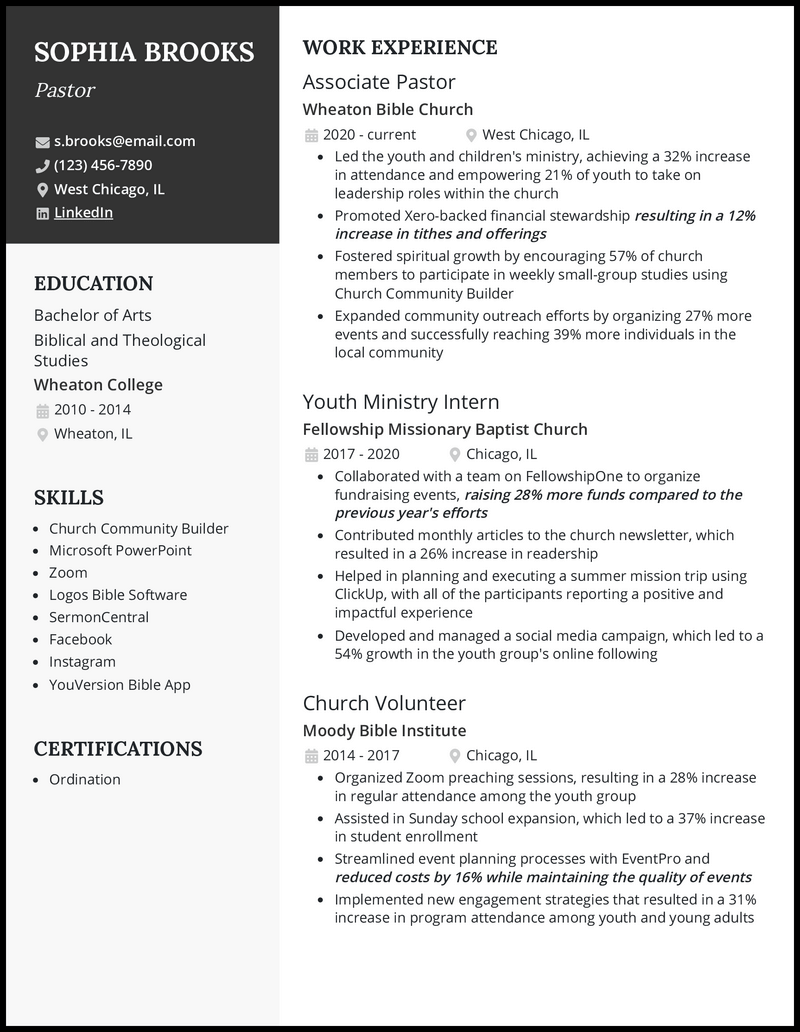
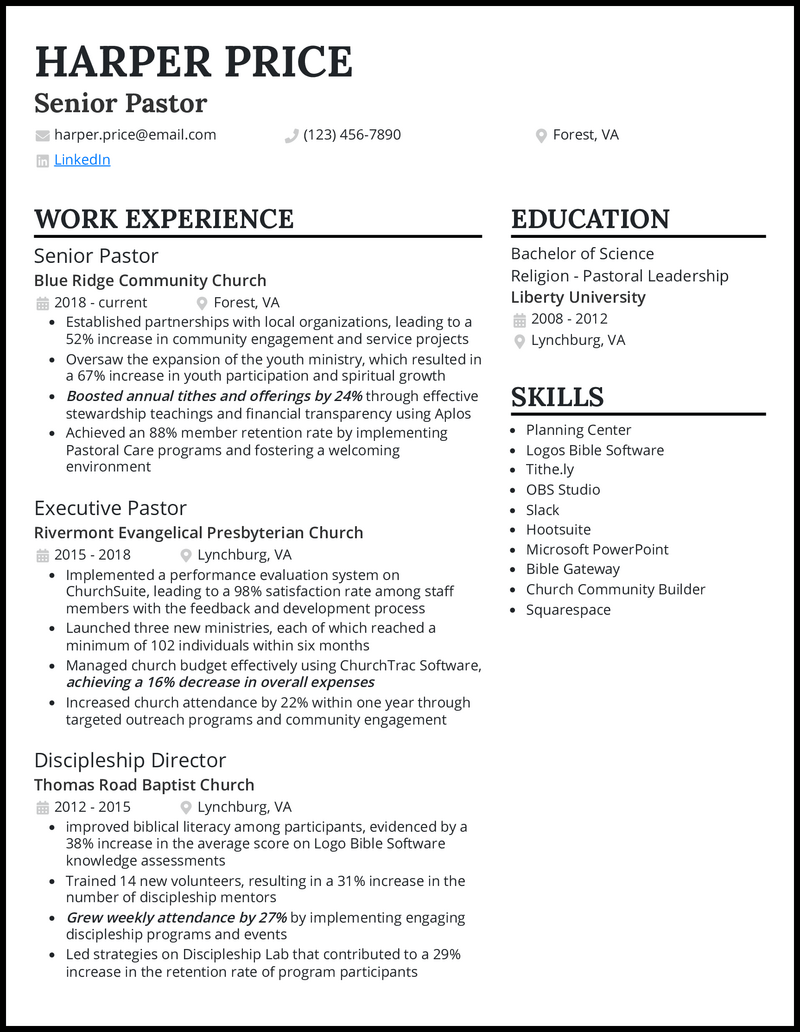
An effective ministry resume should strategically integrate several key sections to fully capture your qualifications and calling. Beyond standard contact information and a professional summary, begin with a compelling Statement of Faith or Ministry Philosophy. This section offers a concise overview of your theological grounding and vision for service. Follow with your Education, emphasizing any theological degrees, Bible college diplomas, or certifications, including the institution, degree earned, and graduation date. If relevant, highlight significant academic achievements or thesis topics that relate to your ministry focus. Next, detail your Ministry Experience, listing positions in reverse chronological order. For each role, provide the organization's name, your title, dates of service, and clear, action-oriented bullet points describing your responsibilities and achievements, quantifying results whenever possible.
Crucially, your ministry resume must also showcase specific skills relevant to the spiritual and administrative demands of ministry. Include a dedicated Skills Section that highlights areas such as preaching, teaching, counseling, worship leadership, youth programming, financial stewardship, volunteer management, community outreach, and digital communication. Do not shy away from listing both soft skills like empathy and active listening, and technical proficiencies relevant to church operations. Additionally, an Awards and Recognition section can elevate your profile, detailing any special recognitions for your service or leadership. For those with extensive volunteer work in faith contexts, a Volunteer Experience section demonstrates commitment beyond paid roles. Finally, consider adding a References section, indicating that professional and spiritual references are available upon request, or even listing a few with their contact information if appropriate for the role.
To truly stand out, candidates should also consider adding sections that reflect a deeper engagement with their spiritual journey and community. A Publications or Presentations section can highlight any theological writings, sermons published online, or conference presentations, demonstrating thought leadership. For those involved in missions, a Missions and Outreach section detailing specific projects, locations, and impact can be highly beneficial. When tailoring your resume for local ministry jobs near you, consider mentioning specific community involvement or geographical familiarity if it's a valuable asset. The goal is to create a comprehensive yet concise document that paints a full picture of your preparedness for ministry, showcasing both your professional capabilities and your heartfelt devotion to service in a clear and compelling manner.
How do I highlight ministry experience effectively?
To effectively highlight ministry experience on your resume, focus on quantifiable achievements and the specific impact of your work within each role. Instead of simply listing duties, illustrate how your actions led to positive outcomes. For example, rather than stating “Led youth group activities,” opt for “Designed and implemented a discipleship program for 30+ youth, resulting in a 25% increase in weekly attendance and participation.” Use strong action verbs such as “cultivated,” “shepherded,” “launched,” “managed,” “mobilized,” or “expanded.” Emphasize leadership roles, project management successes, and any initiatives where you demonstrated strategic planning, problem-solving, or significant spiritual growth in others. Be specific about the size of the congregation or team you served, and the scope of your responsibilities, giving context to your accomplishments.
Contextualize your experience by explicitly connecting your roles to the broader mission and vision of the organizations you served. Detail how your efforts contributed to congregational health, community engagement, or program growth. If you oversaw budgets, mention the financial scope. If you led worship, describe the impact on the congregational experience. For those in roles involving pastoral care or counseling, highlight your ability to provide compassionate support and guidance. When describing volunteer leadership, treat it with the same professionalism as paid employment, focusing on the skills gained and the value delivered. This approach helps hiring committees understand not just what you did, but the significant value you brought to each ministry setting, demonstrating your capacity for future impact.
Furthermore, tailor your descriptions to align with the specific job description of the position you are applying for. Identify keywords and desired qualifications in the job posting and integrate them naturally into your experience bullet points. If a role emphasizes community outreach, ensure your resume highlights experiences where you successfully engaged with external partners or implemented evangelistic programs. If it's a teaching position, focus on your curriculum development and educational leadership. Remember to consider both spiritual and administrative accomplishments. By strategically framing your ministry experience with an emphasis on tangible results and alignment with the target role, you present a highly relevant and compelling narrative that resonates with search committees seeking dedicated and effective leaders in the United States.
What formatting tips ensure my ministry resume stands out?
Ensuring your ministry resume stands out in a competitive U.S. job market begins with clean, professional formatting. Utilize a clear, readable font like Times New Roman, Calibri, or Arial, generally between 10-12 points for the body text and 14-16 points for headings. Maintain consistent spacing and alignment throughout the document to create a polished appearance. Opt for a chronological or hybrid resume format, which typically works best for ministry roles, allowing you to highlight your progression through various positions. Use ample white space to prevent the resume from looking cluttered, making it easy for hiring managers to quickly scan and absorb key information. Remember, visual appeal is crucial; a well-organized resume communicates attention to detail and professionalism, which are highly valued in ministry leadership.
Strategic use of headings and bullet points will significantly enhance readability and impact. Employ clear, bolded headings for each section (e.g., “Ministry Experience,” “Education,” “Skills”) to guide the reader’s eye. Under each experience entry, use strong, action-oriented bullet points to describe your responsibilities and achievements, keeping them concise and impactful. Aim for 3-5 bullet points per role, focusing on your most significant contributions. Avoid dense paragraphs which can deter busy recruiters. Furthermore, ensure consistent capitalization, punctuation, and grammar; proofread meticulously to eliminate any errors. A resume free of typos and grammatical mistakes reinforces your professionalism and commitment to excellence, reflecting well on your overall capabilities as a potential ministry leader.
Finally, tailor the length of your resume to your experience level, but generally aim for one to two pages. For entry-level or early-career ministry professionals, a single page is often sufficient. More seasoned leaders with extensive experience may extend to two pages, but every word must add value. Consider saving your resume as a PDF file to preserve formatting across different devices and operating systems, ensuring it looks exactly as you intended. While creativity is good, avoid overly ornate designs or graphics that might distract from your content or be incompatible with Applicant Tracking Systems (ATS). A clean, functional, and aesthetically pleasing format is key to making your ministry resume not only stand out but also effectively convey your qualifications to potential employers across the United States, whether they are local churches or national organizations.
Where can I find professional ministry resume help?
Finding professional ministry resume help in the U.S. is a crucial step for many job seekers looking to refine their applications. Several specialized resume writing services cater specifically to ministry professionals, understanding the unique language, expectations, and theological nuances of the faith-based sector. These services often employ writers with backgrounds in theology or church administration who can effectively translate your spiritual gifts and experience into a compelling document. Searching online for “ministry resume writing services,” “pastor resume help,” or “church leader resume consultation” will yield numerous options, many of which offer packages including resume, cover letter, and LinkedIn profile optimization. Carefully review their testimonials and service offerings to find one that aligns with your specific needs and budget.
Beyond dedicated resume services, consider seeking guidance from career coaches specializing in ministry or leadership development. These coaches can offer personalized insights into your career path, help identify your unique value proposition, and provide constructive feedback on your resume’s content and presentation. Many theological seminaries and Bible colleges also offer career services to their alumni, which can be an invaluable resource for resume reviews, interview preparation, and job placement assistance. Check with your alma mater’s career development office for support and workshops. Networking within your denominational circles or local ministry associations can also connect you with experienced leaders who might offer advice or even review your resume based on their hiring experience.
Furthermore, numerous online resources and templates are available for those who prefer a DIY approach but need a strong starting point. Websites dedicated to Christian career development often feature articles, guides, and downloadable resume samples tailored for ministry roles. While these can be helpful, always customize templates significantly to reflect your personal experience and the specific requirements of the roles you are targeting. Before finalizing your resume, consider getting feedback from trusted mentors, current or former supervisors, or peers in ministry. Their fresh perspective can help identify areas for improvement, ensuring your resume is clear, concise, and powerfully communicates your qualifications to potential employers across various ministry contexts in the United States.
Key highlights
ministry resume writing tips, essential ministry resume sections, best practices for ministry resumes, where to find ministry resume samples, professional ministry resume services, common ministry resume mistakes, how to tailor a ministry resume, ministry jobs resume format, church leadership resume, pastoral resume guide, spiritual gifts on resume